Bisque firing schedule explained
A bisque firing schedule heats raw clay slowly so water and organics leave safely, then climbs to a low cone like 06 or 04. It opens with a candle near 200 F, eases through quartz inversion at 1063 F (573 C), and finishes around 1888 to 1940 F depending on the cone.
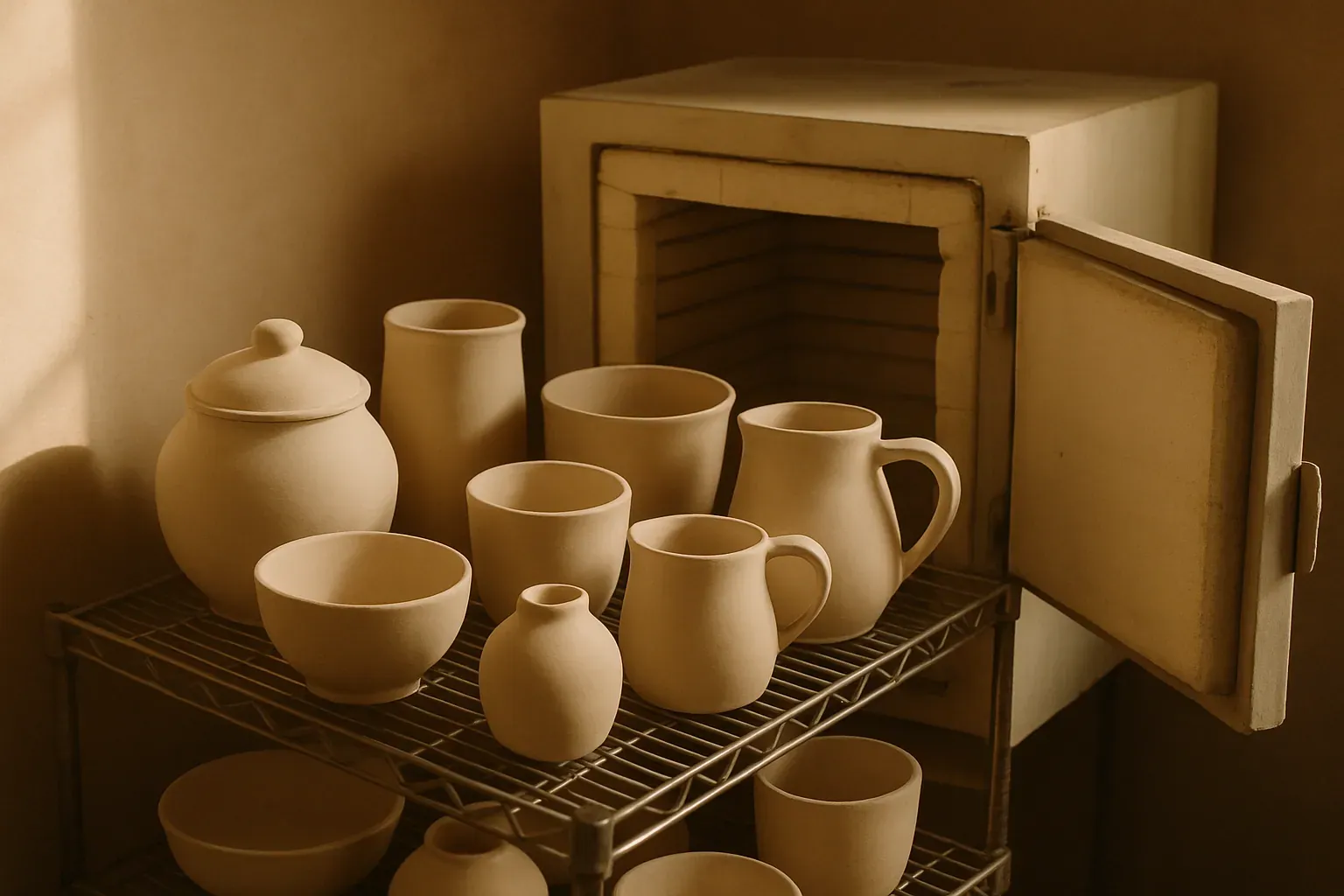
What does a bisque firing schedule look like?
A bisque schedule is a slow climb in stages, each one handling a hazard in the raw clay. It candles low to drive off water, eases up while organics burn out, crawls across quartz inversion, then finishes at the cone. A conservative slow bisque to cone 04 follows the shape below, and it is the program the schedule builder lays out when you pick bisque.
| Segment | Ramp | To target | Zone |
|---|---|---|---|
| 1 | 80 F/hr | 250 F | Candle, water-smoking |
| 2 | 200 F/hr | 1000 F | Organic burnout |
| 3 | 100 F/hr | 1100 F | Quartz inversion (573 C) |
| 4 | 180 F/hr | 1695 F | Steady climb |
| 5 | 80 F/hr | ~1940 F (cone 04) | Maturity |
Heating after a candle at 150 to 300 F (83 to 167 C) per hour up to about 1600 F is a conservative bisque pace that gives organics and sulfur ample time to burn out. Then slow to about 100 F per hour through 1000 to 1100 F to cross quartz inversion safely.
Source: Ceramic Arts Network, Bisque Firing 101 (ceramicartsnetwork.org).Why each stage exists
The schedule is not arbitrary. Each segment answers a real change happening inside the clay:
- Candle and water-smoking, up to about 250 F. Mechanical water turns to steam. Go slow, especially on thick or damp ware, or trapped steam cracks the piece. The candling guide covers how long to hold.
- Organic burnout, roughly 600 to 1300 F. Carbon and organic matter burn off. Keep a vent open so smoke leaves rather than carbon-coring the body grey.
- Quartz inversion, near 1063 F. Silica changes volume suddenly. Ease across it, heating and cooling, to avoid cracks.
- Maturity. The final slow segment sets the heat-work that bends the cone, so it runs steady at the end.
Which cone should I bisque to?
Most studios bisque to cone 06 or 04. A lower bisque like 06 leaves the ware more porous, so it drinks up glaze quickly, which suits dipping. A slightly hotter bisque like 04 makes a sturdier, less thirsty body that is easier to glaze without it cracking off. Your clay maker lists a bisque range, so start there. The Orton cone chart gives the exact temperature for each cone at standard speed.
Build your bisque schedule
Choose bisque in the schedule builder, set your cone and speed, and it fills in the candle, the burnout ramp, the quartz-inversion slowdown, and the climb, then prints a sheet to tape to the kiln. To see how bisque and glaze programs differ, read the bisque vs glaze firing guide.
Sources
- Ceramic Arts Network, Bisque Firing 101 and Techno File: Firing Programs (ceramicartsnetwork.org).
- Bartlett / Skutt / L&L slow bisque factory programs (SDS Industries, kilncontrol.com).
- Orton pyrometric cone temperature chart, ortonceramic.com.
Build a bisque schedule
Pick the cone and speed, and print a slow bisque program with the candle built in.