Candling and preheating to prevent blowups
Candling holds the kiln low, around 180 to 200 F (82 to 95 C), so any water left in the clay turns to steam and drifts out gently rather than flashing inside the wall and bursting the piece. Thin, dry work needs an hour or less; thick or damp ware can want a candle overnight.
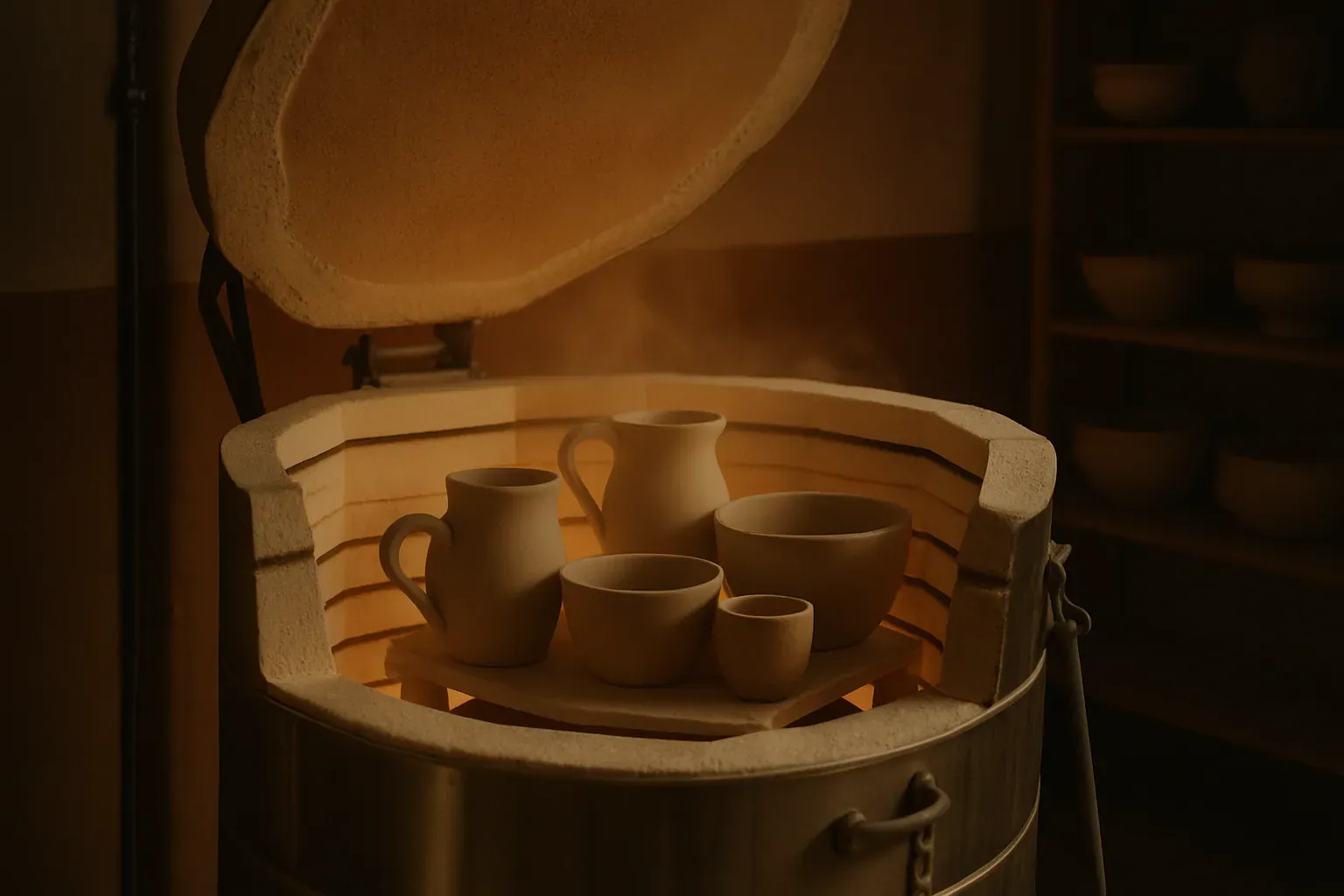
How does candling prevent a blowup?
Candling drives water out of the clay before the kiln gets hot enough to turn it violent. Mechanical water sits in the pores and the thick parts of greenware even when the surface feels dry. Held near 200 F, that water evaporates and drifts out as a gentle steam, called the water-smoking stage. Skip the candle and the same water can flash to steam past the boiling point, expand fast, and crack or burst the piece.
Pottery explodes mainly from leftover moisture. Once the kiln passes 212 F (100 C), trapped water turns to steam and expands fast against air pockets and thick walls. A candle near 180 to 200 F lets that water leave first, as steam, not pressure.
Source: Digitalfire glossary, candling; The Pottery Wheel, why pottery explodes (digitalfire.com; thepotterywheel.com).How long should you candle?
Match the candle to the piece. Thin and dry needs little; thick or damp needs hours. Use the rough guide below and lean longer when unsure, since a slow start almost never causes harm.
| Ware | Candle near 200 F | Note |
|---|---|---|
| Thin, bone-dry | 0 to 1 hr | Often safe with a slow first ramp alone |
| Average studio ware | 1 to 3 hr | Mugs, bowls, plates of normal thickness |
| Thick or sculptural | 4 to 8 hr | Heat needs time to reach a thick core |
| Damp or recently made | overnight | Hold low until you are sure it is dry |
Candling tips that help
- Let the moisture out. Leave a peephole plug out or prop the lid a crack so steam escapes instead of condensing back onto the ware.
- Check for steam. Hold a cool mirror or a piece of glass at the peephole. If it fogs, water is still leaving, so keep candling.
- Slow the first real ramp too. A candle is not a substitute for a gentle early climb. Bisque schedules still open near 80 F per hour to 250 F for the same reason.
- Mind thickness over total size. A thick base or a solid handle traps water longer than a wide thin bowl. Wall thickness, not footprint, drives the risk.
Where candling fits in the schedule
Candling is the first stage of a firing, before organic burnout and quartz inversion. It matters most in bisque, where the clay is raw, but a brief candle helps any firing clear surface moisture. The bisque firing schedule guide shows the full sequence, and the how schedules work guide explains where the candle sits among the segments.
Build a schedule with the candle in place
Pick bisque or glaze in the schedule builder and it opens with a slow candle and a gentle early ramp, then prints a sheet to tape to the kiln. For thick or damp work, add hold time to the first low step before you start.
Sources
- Digitalfire glossary, candling (digitalfire.com).
- The Pottery Wheel, what is candling a kiln, and why pottery explodes (thepotterywheel.com).
- Ceramic Arts Network, bisque firing programs (ceramicartsnetwork.org).
Build a safe firing schedule
Pick bisque or glaze and get a slow candle plus a gentle early ramp, ready to print.